Sunday, May 1, 2011

Neelam Raaj | April 30, 2011


Indian presence in Venice Biennale


The Venice Biennale is often called the Olympics of the art world. The city's palazzos and pavilions see artists - and nations - vying to impress a notoriously hard-to-impress audience. In 2007, Subodh Gupta's pots-and-pans stainless steel skull Very Hungry God was positioned by the Grand Canal and catapulted him to the global stage. This year's event, the 54th Venice Biennale, which will open to the public on June 4, is India's breakout year.


VENETIAN AFFAIR: 

Praneet Soi, who divides his
 time between Amsterdam and his 
native Kolkata, will create an onsite mural 
for Venice while New York-based 
Zarina Hashmi's work tackles
the concept of 'Noor' or divine light
For the first time in decades, India will have a national pavilion (Indian artists such as Subodh Gupta, Riyas Komu and Nalini Malani have shown here but not under a national umbrella). In an exclusive interview, TOI-Crest caught up with Ranjit Hoskote, the man who has been constantly on the move ever since he was appointed curator of the India pavilion last August. Shuttling between Mumbai and Utrecht, the two cities where he has been living over 2010-2011, and Venice and Delhi, Hoskote has been hard at work coordinating with the Lalit Kala Akademi, artists, and with the production team. "Sudden questions pop up, like when electrical facilities pop up in the middle of a mural and we have to make a calibrated deviation from the plan, " says the 42-year-old who wears quite a few hats. A poet, cultural theorist, translator (he's put the launch of his latest book, a translation of the work of 14th-century Kashmiri saint-poet Lal Ded, on hold), he admits that this curatorship is quite a high-pressure job. "Since this is, in effect, our first initiative in Venice on such a scale, we have had to invent protocols and mechanisms for everything. Many people in the art world labour under the delusion that curators lead glamorous lives. What they don't see is the behind-thescenes work, the hard work of negotiation, design sessions, extended meetings, diplomatic discussions, the nuts and bolts of it!" 


Despite a very vibrant art scene, this is the first time India has a pavilion at the116-year-old Venice Biennale. Did you want the debut to make a statement? 

India has had an exhibition presence at previous editions of the Venice Biennale, especially during the 1950s and early 1960s, routed through the Embassy of India in Rome. But after a showing mounted by the Indian Council for Cultural Relations during the 70s, India has been notably absent. Also, after the Biennale reorganised itself substantially at the end of the 90s, we may now see it as a constellation that speaks of a new world order, with greatly transformed regional equations. Within this new constellation, it was important for India to have, for the first time, a professionally curated exhibition commissioned, very appropriately, by the country's National Academy of Art, the Lalit Kala Akademi. So yes, it is vital for me, as curator, that India's debut should mark a strong symbolic statement - in the choice of artists, the complex histories and entanglements they embody, and their place in a newly unfolding narrative of artistic practices that develop across multiple locations. 

Venice is quite the European cultural bastion. What does this mean for Indian art? 

Venice is also still very much the symbolic centre of global contemporary art. It means that we have to attend more responsibly to our status as a cultural power that is taken seriously. The time to celebrate the market uncritically is over. The time to overrate price and reduce artists to lifestyle brands is over. We now have to view our art as something that has powerful critical insights to offer on the layered experience of the present, and to address it through the appropriate optic of knowledge. That is the lesson we have to learn. But I'm afraid we are not going to learn that lesson just yet. There is so much we have to unlearn before we get there. 

The pavilion is somewhat menacingly titled Everyone Agrees: It's About to Explode. 

My eye fell on this sentence, from a text by an anonymous group of theorists called The Invisible Committee, which was shared with me by Mriganka Madhukaillya of the Desire Machine Collective. It was one of those fortuitous, magical moments. The sentence holds a reservoir of multiple meanings. It could speak of a society whose confident energies, simmering discontents, plural and productive articulations are all set to explode. It could speak of an art scene that is on the point of explosion in all directions. It could speak, also, of a cluster of ideas about location, identity, subjectivity and post-postcolonial, transcultural shape-shifting, whose time has come. 

You've chosen four artists - printmaker Zarina Hashmi, painter and video artist Gigi Scaria, mixed media artist Praneet Soi, and The Desire Machine Collective, made up of the husband-and-wife team of Mriganka Madhukaillya and Sonal Jain. Why didn't you choose some of the more established names? 

As I said, it was important for me to make a strong symbolic statement about contemporary Indian art. My argument is that contemporary Indian art is defined by multiple horizons of meaning and value, and not only by the yardstick of the market. 
So, instead of having a vast number of artists to illustrate the booming art scene in India, or merely replicating the conventional wisdom of the art market, I chose four powerful positions, each of them conceptually rich and robust in expressive power. While some of these positions have been incorporated into the ranking system of the gallery world, they have not been neutralised by it - and they enjoy the critical acclaim that correctly attends truly dynamic practices that keep transforming themselves instead of settling into anxious formulae. It was also important for me to point to the variety of locations from which contemporary Indian culture is produced, and that it is reducible neither to place nor medium nor generation.

Zarina Hashmi incarnates, for me, a subjectivity profoundly shaped by the trauma of the 1947 Partition, by the experience of diaspora, and concerned with an exploration of epiphany and illumination. Praneet Soi's transcultural practice allows us to look at the transformation of the studio into a series of fluid situations, shaped through interactions with diverse collaborators, research modes, and a transition among disparate economies of image-production. Gigi Scaria, a Kerala-born artist who has lived and worked in New Delhi for over a decade, reflects on the processes and demands of internal migration, travelling among diverse psychic landscapes, social textures and interpersonal asymmetries. The Desire Machine Collective, based in Guwahati, signal the emergence of a vibrant contemporary art scene in the north-east, a part of India that is often regarded as quite separate from the mainstream - they combine their own work in film and public art projects with the conferences and workshops they organise through PeriFerry, a platform based physically on a barge moored on the banks of the river Brahmaputra.

In this sense, the India pavilion is, for me, a laboratory to test out various conceptions of cultural citizenship, of a cosmopolitanism that is not exclusively based on the metropolitan condition. I use the Indian Pavilion as a laboratory to investigate the idea of India. Through the four artistic positions presented there - as well as through the three associated conference platforms that will follow, in India - I bring into play the many claims and counter-claims, the extensions of conceptual boundaries and the multiple locations within the subcontinent from which artists now work, as ways of opening up the idea of the nation-state. Cultural citizenship, rather than national identity, is one of the key themes that I am exploring through this experiment. 

What are the works that will be on display? 

There are seven works in all. I have chosen three existing works by Zarina Hashmi - Home is a Foreign Place, Noor, and Blinding Light. We have produced a 35 mm film version of an earlier work by Desire Machine Collective, Residue, and a new recension of Praneet Soi's slide-projection-based work, Kumartuli Printer. The new works that I have commissioned are a mural that Praneet Soi will paint onsite, and a threescreen video installation by Gigi Scaria, called Elevator from the Subcontinent. 

There has often been the discussion that Venice, with the national pavilions, is an obsolete model. Two years ago, you wrote a column in The Times of India arguing against a national pavilion which you said was an outdated idea. Now that you are curator, have you changed your mind? 

My argument, in that text, was polemical and intended to draw attention to the possible dangers of the national pavilion format, and of interpreting the logic of national pavilions literally rather than creatively.


Among these was the danger of trying to 'represent' the nation through some form of heavy-handed regional or constituencybased quota system, and the pressure that this would place on the curator. The other peril that I pointed out was that artistic practice is increasingly moving away from the nation-state as unit of cultural measurement, and assuming fluid, entangled, transcultural, hybrid forms.


I am happy to say that the commissioning body for the India pavilion, the Lalit Kala Akademi, made it absolutely clear from the very beginning of this project that I would not be subjected to any kind of pressure in my curatorial work, as to choice of concept and artist. And the Akademi has supported me completely in this.


As to the critical engagement with the nation-state, the national pavilion becomes the ideal setting for such a revisiting of the idea. As I have said, the pavilion can be opened out and turned into a laboratory in which to test out notions of how we belong, and to what we belong - what does it mean to subscribe to a notion of cultural citizenship, to be related to a dynamic set of ideas concerning India rather than the textbook image of a territory. 

The site of India's pavilion is the Arsenale, a sprawling complex of docks and warehouses. It sounds architecturally arresting. 

PERIFERRY TO CENTRESTAGE: 

The Desire Machine Collective, based 
in Guwahati, signal the emergence of a vibrant 
contemporary art scene in the north-east.
'Residue', a video shot at an abandoned thermal 
power plant, was shown last year at the 
Deutsche Guggenheim in Berlin. (Top) Gigi Scaria's 
installation is called 'Elevator from the Subcontinent'
The Arsenale is the former ship-building yard and weaponry production centre of the Venetian Republic, as it used to be for centuries, a great trading and maritime power controlling the Mediterranean, until it collapsed under Napoleon's attacks and was eventually annexed into the newly formed nation-state of Italy in 1866. The Arsenale is a fantastic place, redolent of history, grotty, with exposed concrete and unfaced brick walls, huge columns, vast empty bays. I never cease to marvel at how this ruin-like space is transformed, with each edition of the Biennale, into the magical stage where some of the most inspiring contributions of contemporary global art are presented. 

How seriously does China take cultural platforms like Venice?

China takes its soft-power initiatives very seriously. The Chinese presence in Venice, as in most other centres and off-centres of the global art scene, is substantial. Their pavilion has been curated by the Beijing aesthetician Peng Feng and is titled Pervasion of Chinese Flavours. Its project is to weave traditional Chinese aesthetic conceptions with contemporary idioms of practice, a tendency that is prominent in contemporary Chinese art. That said, China cannot wish away the fact that, when art oversteps the boundaries laid down for it by the state, the official reaction is tumultuous. China has recently embarked on a campaign of persecution against the artist Ai Wei Wei, who has expressed himself firmly on behalf of cultural and political openness. This has generated enormous dismay and protest across the global art scene.

Friday, April 29, 2011

The Economic Times


India gets its second international art fair

IANS, Apr 27, 2011, 12.53pm IST


  • New Delhi|

  • Kochi-Muziris Foundation

  • NEW DELHI: After the success of the India Art Summit in Delhi, the scene of action in contemporary art is shifting south with the announcement of the Kochi-Muziris Biennale 2012, a mammoth exposition of international contemporary art, in Kerala.
    A statement issued by the Kochi-Muziris Foundation Tuesday said the fair would be held in the Kochi port city on the scale of international art fairs.
    A brainchild of Riyas Komu and Bose Krishnamachari -- two Kerala-born leading contemporary artists who left their native shores years ago, the biennale will showcase the best of Indian and international contemporary art with discussions, education sessions and corollary events themed on art. It will be modelled on the India Art Summit and the global art fairs.
    The fair will be partnered by the Kochi-Muziris Foundation, a non-profit trust formed in 2010 that aims to highlight cosmopolitan legacy of the modern metropolis of Kochi.
    The biennale will be spread across multiple venues in Kochi town and the adjoining port city, which was known as Muziris in early history.
    The works on display will be a multimedia panorama of conventional art, films, installations, sculpture, new media and performance art. The biennale will also create a platform for debate by introducing ambitious contemporary international visual art practices and theory to India, showcasing new Indian and International art, and enabling a dialogue among public, artists, curators and visitors.
    "The regional contemporary art from Kerala will occupy a pride of place," the foundation said in its statement.
    The exhibition will try to create linkages between the tangible built heritage of the ancient Jewish settlement of Muziris, which has been continuously inhabited since the pre-Christian era, and visual arts by using public spaces, heritage buildings and other non-traditional venues to display art.
    The ancient port city of Kochi was once known for its busy spice trade and was the landing ground of the first Dutch settlers in southern India. It was also home to Jewish traders. The ancient town of Mattancherry in Kochi was the nerve centre of pepper and cardamom trade.
    According to the organisers, the art fair is proposed to attract national tourism, cultural interest and promote social cohesion to project Kochi as a heritage and art tourism destination.
    The event will be supported by the Kerala Tourism department, local and national stakeholders and creative industries.
    Return to frontpage


    Showcasing the rich art forms of India


    KAUSALYA SANTHANAM


    This book celebrates the presence of the divine even amidst the mundane and the material in our country. It showcases popular, devotional art in India and also metal icons, masks, sculptures, puppets, and ritual objects of divinities from this country as well as from Thailand, Nepal, Tibet, and Indonesia, as displayed in the Museum of Sacred Art, Radhadesh, Belgium.

    REFRESHING

    It is an effort to show “how contemporary artists continue to create visual representations of Hindu divinities in new and refreshing ways.” Radhadesh being “a spiritual community belonging to the International Society for Krishna Consciousness (ISKCON),” it is only natural that a majority of the paintings in the book should be on Lord Krishna.

    A separate section is devoted to the art of the Hare Krishna movement which was also influenced by Italian art and Russian artists. The clarity of photographs, especially that of the beautiful old castle where the museum is housed, is such as to transport the reader to the museum. Also included are brief biographies of the artists.

    J. Bhagawati, Ambassador of India to Belgium, Luxembourg, and the EU, in his preface, mentions how the collection “reflects the rich multiple art forms of India.” In her foreword, Chistiane De Lauwer, Curator (South Asia), MAS/ Ethnographic Museum, Antwerp, says she was struck by the lack of knowledge in Belgium about one of the world's most ancient and rich cultures. So, she went on to study Indian art, language, and religion. The museum and catalogue grew out of the need to spread awareness on Indian spiritual art.

    Unlike in the West, the genre of spiritual art is still vibrant in India, says Martin Gurvich, Director, Museum of Sacred Art, in his introduction. The museum's focus is on living art forms rather than historical pieces, and so most of the pieces are from the 20th and 21st centuries.

    In her essay on the “Living Traditions in Indian Art: The Divine Image,” Tryna Lyons describes how spiritual art is found everywhere in the country and goes on to speak of the art and artists in various regions. Among the beautiful photographs featured from the museum collection are the ones of Lord Krishna with Radha, with gentle-eyed cows, with the gopis on the river bank. Gold-leaf worked paintings in the Tanjore style and Mysore style; the pichhavais (cloth hangings) from Nathadwara in Rajasthan; paintings on cotton and paper by artists such as B.G. Sharma and Indra Sharma; inlay work on wood from Karnataka; beautifully proportioned bronzes of Tamil Nadu; eye- catching Madhubani paintings from Bihar; and rod puppets from Indonesia also find a place. In all, a catalogue that compresses the essence of the museum exhibits and communicates the spirit of popular and contemporary Indian spiritual art to the West.

    Wednesday, April 27, 2011

    Gaitonde Painting is Top Seller at Pundole Auction
      BY CHELNA KHATAU   APR 22ND 2011 AT 6:00AM


    NS Bendre's Mother and Child

    An untitled painting by India's master abstract artist VS Gaitonde was the top-selling lot at the Pundole Gallery's inaugural art auction. The art sale, held at the National Centre for Performing Arts in Mumbai on April 20 raised a total Rs.11,51,70,000. And Lot 11, the Gaitodne, sold for an impressive Rs. 2.97 crore, almost Rs. 70 lakh more than the pre-sale upper limit of Rs. 2.20 crore.

    The Gaitonde and 19 other works sold were from the NCPA's collection, which included works from Jamshed Bhabha's private art collection as well. An auction highlight was the staggering price achieved for a landscape by Bhabha. The 1945 painting, estimated to sell for between Rs. 50,000 - Rs. 70,000, went for Rs. 15.4 lakh. 

    Also, a world record was set for a NS Bendre painting. His 1980 oil on canves of a mother cuddling her child (aptly titledMother and Child) sold for Rs. 99 lakh. 

    Bids came in from India as well as the United States, Hong Kong, Japan and Europe.

    Monday, April 25, 2011


    A home for Jehangir's collection

    Saloni Doshi | April 23, 2011

    The magnificent collection of Jehangir Nicholson finally finds a home.

    ONE FOR THE ALBUM: Nicholson, who liked to introduce himself as RK Laxman's Common Man, with his wife Dina. It was after her death in 1967 that he took to collecting contemporary Indian art seriously.
    ONE FOR THE ALBUM: Nicholson, who liked to introduce himself as RK Laxman's Common Man, with his wife Dina. It was after her death in 1967 that he took to collecting contemporary Indian art seriously.


    On the evening of April 11, the doors to the Jehangir Nicholson Art Foundation's first exhibition, Six Decades: Celebrating the Bombay Artists from the Jehangir Nicholson Collection, opened at the Chhatrapati Shivaji Maharaj Vastu Sangrahalaya (CSMVS), formerly known as the Prince of Wales Museum in Mumbai.

    It was an important moment in the history of post-colonial Indian art. Finally, one of India's most passionate collectors was being given the respect and space he deserved in a gallery named after him. The works on display represent only a sliver of a collection that consists of close to 800 paintings, sculptures, drawings and prints acquired from 1968 to 2001 of 250 Indian artists. The oldest artwork dates back to 1930.

    The current exhibition showcases works of Bombay artists such as Sadanand Bakre, Prabhakar Barwe, MF Husain, Francis Newton Souza, Adi Davierwalla, Tyeb Mehta, HA Gade, VS Gaitonde, Bhupen Khakhar, Jitish Kallat, Anju Dodiya, Atul Dodiya, Nalini Malani, Akbar Padamsee, Homi Patel, Sudhir Patwardhan, Gieve Patel, Piloo Pochkhanawalla, SH Raza, Jehangir Sabavala, Laxman Shreshtha, Mohan Samant and B Vithal.

    DINING OFF ART: Artworks lined Nicholson's dining room at his Worli bungalow, Westmore.

    The Jehangir Nicholson Collection tells the story of contemporary Indian art. What was perhaps most important to the pint-sized collector was to collect works from different phases of an artist's life so that he had a record of the artist's progress and passage. He wasn't happy just to have one token work from every important artist. The works of Raza and Laxman Shreshtha's shifting phases, for instance, are dramatically evident in the collection, as Nicholson bought them steadily from the forties onwards. As art critic Ranjit Hoskote says, "These paintings demarcate a rich universe of concern, revolving as they do around the relationship between an ironic human consciousness and a vast cosmos that speaks to it in polyphonic voices and signs ablaze with mystery."

    Jehangir Nicholson or Jangoo Bhai, as he was fondly called by his close friends (1915-2001 ), was born into a wealthy Parsi family that had established itself in the raw cotton trade. He grew up to take charge as director of the family's cotton selection and purchasing agency, Bruel and Co. However, Nicholson himself was a trained chartered accountant, and among his many social roles was Sheriff of Bombay, a post that he held for one year, and advisory board member to the National Centre for the Performing Arts (NCPA). Tragedy struck in 1967 when his beloved wife Dina passed away. They had no children.

    It was grief that made Nicholson embark on his voyage as a collector of contemporary Indian art. Devastated by his wife's death, he began to fill the vacuum in his life with things of beauty. In the '60s, art was not fashionable, nor was it pursued as a hot investment. Paintings and sculptures of local artists were not thought to be worth more than a few hundred rupees. Recalls Laxman Shreshtha, "In the 70s, when art collector Bill Chaudhary bought Souza's master work Death of a Pope (now in the Nicholson collection) for one thousand rupees, Souza made a statement that he earns more money than the prime minister."

    Saturday, April 23, 2011

    TIFR to exhibit rare artwork assembled by Homi Bhabha

    Express news service

    Posted: Apr 22, 2011

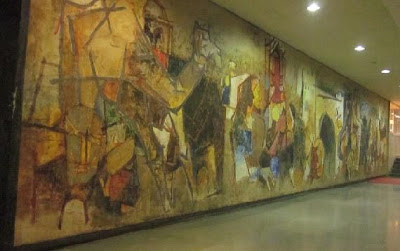
    The famous, breath-taking Husain mural, "Bharat Bhagya Vidhata". Painted in 1964, the most spectacular work in the most amazing collection...


    Mumbai Homi Jehangir Bhabha has always been remembered as one of the founders of modern science in India. But many do not know that he was also an artist in his own right. Not only was he passionate about paintings, music and literature, he is known to have mastered the arts to perfection.

    In a fitting tribute to its founder, the Tata Institute of Fundamental Research (TIFR) is, for the first time, bringing together a rare collection of painting and sculptures, to be exhibited for the wider public. Consisting of over 250 artworks, the collection was assembled by the first two directors of the institute, Bhabha and MGK Menon, between the early 1950s and 1970s. Of this, the exhibition titled ‘Homi Bhabha and modern Indian art: the collection of TIFR’ at the National Gallery of Modern Art (NGMA), will showcase over 130 paintings and sculptures.

    “It was Bhabha who set the tone for acquisitions, securing a set percentage of the institute’s yearly budget on art. He was a connoisseur of the highest rank. One of his paintings was recently sold at an auction for Rs 14 lakh. The exhibition will showcase the highlights of one of the most important collections of modern Indian art in existence. Though the TIFR art collection has a well-established reputation among the academic community, the works have rarely been viewed by a wider public. It’s only fitting that a substantial part of the collection be showcased,” said Kishore Menon, public relations officer, TIFR.

    “The artwork being showcased is one of the finest produced in the post-Independence period and it’s fantastic that Mumbai will get to see one of the country’s greatest collections,” said Mortimer Chatterjee, the curator.

    The art collection boasts of some of the largest numbers of work by K H Ara, V S Gaitonde, Krishen Khanna and K K Hebbar. It also includes Tyeb Mehta, Baburao Sadwelkar, Badrinarayan, M F Husain and Jehangir Sabavala. The exhibition at NGMA will be inaugurated on Sunday and will be open to the public Monday onwards.

    “TIFR is the only scientific institute in the country which has such a rare art collection. It also highlights Bhabha’s contribution to arts and his attempt at a synthesis of arts and science, which is reflected in his ideas and the institutions he created,” said professor Spenta Wadia, convener of the TIFR endowment fund, who has been overseeing the collection.

    Sunday, April 17, 2011

    http://www.thehindu.com/arts/magazine/article1696047.ece?homepage=true&sms_ss=email&at_xt=4daa546334f373b9%2C0

    Return to frontpage

    Rooted in the every day

    SHIVAJI K. PANIKKAR

    With his latest series “Frontal Narrative Sculptures” exhibited during the recent Chennai Art Summit, sculptor S. Nandagopal looks back at his four decades in the art world.

    Nandagopal at work in his studio. Photo: Bharat Sikka

    Sculptor S. Nandagopal's “Frontal Narrative Sculptures” uses commonly found articles like ladles, hooks and cleavers in a series of whimsical yet interesting bronze and copper works. Nandagopal continues to blend the ancient with the modern as he infuses figures from Hindu mythology with his innovative style.

    “Frontal Narrative Sculptures” was hosted by Artworld as part of the Chennai Art Summit last month. During a conversation before the exhibition, the sculptor traces his artistic journey of 40-odd years.

    The art scene in the 1960s and 1970s in Madras had been vibrant. As a young art student in the Madras Art College and later as a young professional, what were the sources of inspiration you gathered from the local and international art scenes that enabled you to develop a personal sculptural language?

    I studied at the Government College of Arts and Crafts in Madras in the 1960s and 1970s when the Madras Movement was at its height. It was a marvellous place. I owe much to its curriculum, setting and remarkable ethos. It had an excellent craft section where I used to spend a lot of time. It had some of the most renowned craftsmen in the state: ironsmiths, goldsmiths, furniture designers, textile weavers, dyers and so on, working and teaching alongside artist-instructors in painting and sculpture. There was an arrangement by which one doing painting, for instance, could go across and work in the sculpture section or in the ceramic workshop, textile design section or in the workshop of any other master craftsman. I would therefore move around in the workshops and observe the craftsmen at work, assist them sometimes or go over work in progress in the workshops and studios of craftsmen, painters or sculptors I looked up to. I knew very little about art those days but I could react to its workmanship no matter what medium and could be quite carried away by it.

    In the late 1960s and early 1970s when I was there, a number of painters and sculptors were doing outstanding work. There was so much interaction, initiative and upsurge that I felt some of it happening inside me too. There was an important movement on. Notable among those I personally empathised with were the sculptor P.V. Janakiram, and the painters Reddeppa Naidu, L. Munuswamy and A.P. Santhanaraj.

    I am particularly indebted to a school of drawing my senior colleagues and teachers had developed. It consisted of a line as soft and spontaneous as a Japanese brush stroke and just as free. With that they had developed a figure drawing that was so structured that it could do such complexities as an elephant-headed presence or a monkey-mannered wind-borne spirit or one that could multiply its limbs, head and body at will or issue out into configurations of calligraphic signs. That drawing remains with me and nourishes me still. It is that which activates my sculpture. On the international front, I have studied the work of abstractionists David Smith, Anthony Caro and Michael Puryear but remain a figurative sculptor as I believe that “Man will remain Man's greatest subject”.

    Can you describe/characterise the major shifts that have come about in your sculptural articulations in the last four decades?

    Like most sculptors of the Madras Art Movement, I began my career as a painter before I took to sculpture full time. My early work was inspired by folk and iconic sculpture and “frontality” was a key element right from the start. There were, of course, a few instances where I ventured into third dimensionaliy but I was unhappy with it as I felt it reached a dead end. The 1960s were a turbulent time in the Indian art movement when a synthesis of the West and the East was pursued relentlessly. Reviewing my work in Art International, the critic Phyllis Granoff gives an insight into my early work: “Nandagopal's sculptures are often large but perhaps their most obvious characteristic is that they compel the viewer's attention in two strikingly different ways. They first impose themselves as objects isolated in space and then invite a close-up reading of their numerous surface details. This remarkable synthesis of large imposing external shape with intimate playful surface detail Nandagopal himself relates to India's ancient artistic tradition, both folk and courtly.

    The 1970s saw a consolidation of “frontality” and “linearity” in my sculpture. The late Dr. Mulk Raj Anand's view on my work at this stage gives you some idea. “The vision of Nandagopal conjures up images which are startling with their twists and turns of the figure. The sensation of the onlooker has to yield to deeper realisations of the subterranean currents of our age and transition. The aesthetic of Nandagopal's sculpture is in the disharmony which compels the overflow of emotion. Beneath the outer form with the violent gestures one can see the shadows of delirium of the human soul.”

    The 1980s saw a subtle change coming into my sculpture. The critic and theoretician late James Josef commented on the element of lyricism that was creeping into my work. “The medium and workmanship in which Nandagopal has excelled has a lineage and history in mainstream world sculpture from which he has certainly taken his lessons. But it was the developments in Madras and especially the developments in pictorial figuration which really launched Nandagopal.”

    From the early 1990s and into the new millennium, my work has taken on a new phase: the narrative element. Geeta Doctor sums it up aptly: “He calls them ‘Frontal Narrative Sculptures'. This however gives no idea of the exuberant quality of Nandagopal's series of copper and brass pieces. They soar and leap into space with all the power and grace of a traditional piece of South Indian art, whether chiselled on stone, as they are at Mahabalipuram or the exquisite bronzes of the Chola period. Yet they are rooted in the every day.”

    As a sculptor, you have done very large to very small sculptures. What are the formal, technical and other considerations while undertaking such different projects in different scales?

    My work varies from very small sculptures to monumental ones. My work at Priyadarshini Park, Mumbai, commissioned by the National Centre for the Performing Arts, is 20 ft tall and the Garuda at the headquarters of the Transport Corporation of India Ltd in Gurgaon in 15 ft tall. As they were to be placed open to the skies, they had to be made of a material that would not corrode. Hence both sculptures were fabricated from stainless steel, which is a wonderful material for outdoor purposes. When it comes to interiors, I prefer to work with copper and brass, which when polished and coated with a polyurethene film lasts for a very long time.

    Shivaji K. Panikkar is an art theoretician and has served as head, Department of Art History and Aesthetics, M.S. University, Baroda.